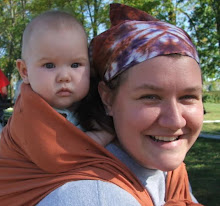
Friday, May 11, 2012

What attachment parenting means to me

Everybody's going crazy about this Time Magazine cover. I've had a lot of thoughts about it and read a lot of responses. Fortunately, most of them are of the "we all need to just shut up and stop judging each other because there is no one right way to parent" variety. However, some of them (and some of the comments accompanying them) grossly mischaracterize the Attachment Parenting philosophy. Here's a representative sample:
[P]arents must wear their babies as an appendage at all times, sleep with their babies lest they feel abandoned for 8 hours, breast-feed for at least one year to even be considered a mom, and pretty much arm your children with zero independence, no self-soothing skills and ensure that they need mommy and daddy for ev-er-y-thing until they at least 15.
OK, so maybe this blogger is being a little tongue-in-cheek, but this seems to be a pretty common (mis)conception of AP.

As someone who believes in Attachment Parenting, this bugs me. So I'd like to straighten a few things out.

First off, AP is by no means proscriptive. It is a philosophy, not a strict practice. There are no "musts." At first I thought maybe I was misremembering things, so I consulted my dog-eared copy of The Baby Book and I was right. Time and time again throughout the book, Dr. Sears emphasizes and re-emphasizes that not all techniques work for every family. The point is to do whatever works for your family to engender a secure attachment between you and your kids, which is the real aim of AP. That is the real message of The Baby Book, and the heart of Attachment Parenting: the idea that if you trust your instincts, respond appropriately to your kids' cues, and treat your child with respect and understanding, parenting can be more successful and rewarding. That seems pretty straight-forward to me, and not at all controversial. I am sure there are militant AP-ers out there who take things too literally and too far and just ruin it for everyone; but I don't personally know any, and I know a lot of AP moms.

So here is what AP has meant for me, following the main tenants of attachment parenting:

1) Birth Bonding
I chose to take an active role in the births of both my girls, not just because I am very interested in childbirth (shocker!), but because taking ownership of the births helped me feel confident as a mother from the get-go. Although neither birth unfolded exactly as I imagined (they never do), I was able to confidently mother my girls from their earliest hours, something I believe would have been more difficult if I hadn't taken on an active role during their births. In fact, although Freya's birth was just as long and intense as Ren's, my greater sense of agency during Freya's birth definitely helped me be a more confident mother to her sooner than I was able to do with Ren.

2) Belief in the signal value of your baby's cries
I don't believe that if I let my baby cry, she'll develop brain damage. Although Dr. Sears is accused of promoting this idea, I also don't recall reading about it in his book. (I have read stuff on how being left to cry can be stressful for a baby, but not to the level of brain damage). Anyway, the reason I respond as soon as possible when Freya cries is the same reason I respond when Erik asks me a question: I think it's rude to ignore someone who is trying to communicate with me. Ignoring her sends the message, "I don't care what you need right now" and I just don't want to send that message to someone I love. Plus, the crying stresses me out physically as well as emotionally and it's just easier on all of us if someone tends to her needs.

With an older child like Ren, of course she can communicate without crying, and she can also try to manipulate me. But fortunately after 4 years of watching closely and responding promptly to her cues, I have a very good sense of what she's trying to communicate at any given time, whether she's faking it, and how to respond. Being responsive can be emotionally and mentally demanding, and sometimes physically demanding, as when a child needs to be held or rocked for long periods. But ultimately I've found that for me it's made parenting more joyful and less confusing and anxiety-inducing.

However, being responsive does not equate to being lenient. This is another big misperception. I have no problem telling Ren "no" if I need to, even if it breaks her heart. She hears "no" a lot. But I'm willing to work to figure out what she needs, and I'm not going to deny her something she truly needs if it is in my power to give it to her, even if it might be inconvenient for me. If her needs and my needs clash, then I figure out a compromise, just like any other two people who love each other might have to do.

3) Breastfeeding
Breastfeeding works for our family. I get that it does not work for all families. In a different situation, say if I had had to work full-time away from home when Ren was an infant, I would have supplimented or formula-fed with no guilt. You gotta do what you gotta do to nourish your kids and keep yourself sane. But for me, breastfeeding is the best, easiest and most fun way to feed my babies. And seriously the laziest. No way I was going to deal with formula and washing bottles if I didn't have to, let alone preparing bottles in the middle of the night. Ugh. Kudos to the moms and dads who choose to do it, or who do it because they don't have a choice.

I could have been the women on that Time magazine cover, except I'm not nearly as attractive as she is. But I did nurse Ren until she was 3 and a half. I didn't plan to breastfeed as long as I did with her. As she got older, there just never seemed a good reason to wean. It made her so happy and was not really any trouble to me, so why not keep going? Then when I got pregnant and it was painful every time she latched on and she didn't seem as dependent on the comfort it provided, we weaned. It really was never a big deal one way or the other, although apparently I'm an outlier and a freak and possibly a pedophile... Anyway, we'll see what happens with Freya. She might go longer than Ren did, she might self-wean at 18 months. I might need to stop nursing for some reason, medical or otherwise. Either way, we'll stop just as soon as one or the other of us is ready to stop. But I will forever cherish the time I spent nourishing them, with them in my arms looking up at me. I'm sure all parents feel that way, whether their baby was on the other end of a breast or a bottle.

Oh, and I don't believe I ever nursed standing up and looking defiant while Ren stood on a chair looking huge and a little shell-shocked. Seriously, they found the most gargantuan three year old they could for that picture, didn't they?

I feed on demand because that is the way I eat. Eat when you're hungry; stop when you're full. (I still need to work on that second one). It just never made sense to me to impose a somewhat arbitrary schedule on a baby or a kid, and this belief links back to #2.

4) Babywearing
Helps me get stuff done around the house, and it's a lot easier to slip a baby in a sling than to lug 20 pounds of baby + car seat around. I'll happily use a stroller when going long distances if it's a place where the stroller isn't a PITA.

5) Bedding close to baby
Once again, laziness. Ren could not sleep alone. Not would not; could not. For all of our sanity, she had to be in the bed with us. On the other hand, Freya will happily sleep in her bassinet, so that's where she is for the first part of the night. When she wakes up hungry, I take her out of the bassinet, put her next to me, stick a boob in her mouth and go back to sleep. We all get the most sleep this way. If co-sleeping equals sleep-deprivation for your family, DON'T DO IT! It's dangerous to bedshare if you're sleep deprived, anyway.

6) Balance and boundaries
This is the one the "AP is EXTREME! It's anti-feminist! It's for martyrs!" folks forget about. Yet it's one of the main tenants of Attachment Parenting! It's right there in the book: it's about "knowing when to say yes and when to say no, and also having the wisdom to say yes to your own needs." This has served me well and really cuts down on the mama-guilt factor. So, yes, I work part-time while the girls are at daycare, I go out with my friends, I have an occasional drink, I take a night off once in a while to be by myself, and I sometimes let the baby cry while I am in the bathroom or the shower. I still call myself AP with no hesitation.

7) Beware of baby trainers
At heart, this just means follow your own instincts and take every one else's advice with a grain of salt. I'd be utterly lost without my instincts, paralyzed by anxiety. If I didn't trust myself to be a good mom, I'd have nothing to fall back on in an emergency or when my situation deviates from the norm. Which is all the time, because no one's parenting situation is totally "normal." There is no one-size-fits-all parenting plan, so you've got to trust yourself to craft a style that works for your family.

This last point sums up all the others for me: I follow numbers 1-6 to one extent or another not because The Great Dr. Sears tells me to, but because that's pretty much what feels right to me anyway. If any of it didn't feel right or didn't work for my family's situation, I wouldn't do it.

Note that these foundations of AP do not address cloth diapering, eating organically, intactivism, elimination communication, home schooling, or any of the other things commonly associated with "the AP lifestyle."

I have benefited from the philosophies behind attachment parenting in a lot of ways. It has helped make me a more confident, happy, well-balanced mother. I think it's doing good things for my kids, too. Certainly no one who knows Ren could say she has "zero independence, no self-soothing skills" and she "need[s] mommy and daddy for ev-er-y-thing." I don't think AP is the only way to raise happy, well-adjusted children, but I do think that if you want happy, well-adjusted children, then having confident, happy, well-balanced parents is a great place to start.

Wednesday, March 21, 2012

Freya's birth story

Wednesday, March 7th -
appt with Dr. Susa @ 38 w; Dr. Hartung out of town. Blood pressure 150s/90s and won't go down. Starting to think about induction sooner than later; 2cm, 50% effaced, and soft. Made an appt for Friday w/ 24 urine.

Friday, March 9th -
3:00pm - assuming I will probably be induced, mom comes to the appt and we bring my hospital bag. Protein and BP both down, but after talking with Susa (Hartung booked) we decide it's probably time to move on this.

4pm - admitted to hospital for induction. The plan is to break my water first, then start pit if necessary. Mom is with me and Erik is planning to come after work.

5pm - they inform me that due to low staffing overnight and two moms in labor (one with twins), we can't start the induction until morning. Susa says I can stay in the hospital and they'll break my water at 6am, or I can go home and come in for a 7:30a induction. We opt for me to stay. Erik stays the night with me; mom and dad and Ren stay at Diane's. I take advantage of the big birthing tub and E and I watch some Arrested Development. Try to get some sleep but the bed is really uncomfortable.

Saturday, March 10th -
3am - regular contractions start spontaneously and I'm too excited to sleep. Walk the halls and watch TV for a while. Contractions are very mild and breathable, like the ones I've been having for a couple weeks. They don't get stronger and closer, but they don't go away either.

7:30am - Rachel arrives, Erik leaves. We are informed that the twin mama is still laboring and they can't induce me until she's done. The nurse says, "Your induction WILL be some time this morning." I think, does that mean I might have to wait until noon!? Little did I know...

morning - hang out, eat breakfast, check out the art in the halls, breathe through prodromal contractions...

At some point mom, dad and Ren visit and we play in the rock pond in front of the hospital in the unseasonably gorgeous weather. By noon the twin mama still has not delivered ("She's pushing! She's *this* close!")

It has been exactly six weeks since I sat sobbing in my car in the driveway after Dr. Susa called to tell me I have pre-eclampsia again.

around 1p - Susa walks in and says that even though the twin mama is still laboring, he wants to get the show on the road. I'm still at 2cm, 50% effaced, baby at station -1. I'm nervous. Rachel and I listen to the second movement of Mozart's Sinfonia Concertante (the 1982 Perlman/Zuckerman live recording) and it helps calm me down.

1:45p - Susa tries to break my water (REALLY PAINFUL!!), but baby's head is so engaged it's hard to tell. We call Sarah to come. Contractions continuing, slightly stronger than before? Or wishful thinking?

afternoon - Walk the labyrinth outside the hospital. Walk the stairs. Look at art. Sarah arrives. We chat. I labor. Contractions still regular, but have not picked up much.

After dinner we're going to start the pitocin. My saline lock, which was inserted over 14 hours ago and has never been used, is not working and it takes five more attempts to place a new one.

7:30pm - we start the pit, and try again to break my water (ow), since we're still not sure if it's broken. The pit plan is to start at 2 and increase by 2 every 15 minutes until I get a regular pattern. The contractions get stronger. I'm feeling good, laboring well. With the pit at 8 we seem to have reached a regular labor pattern so we stop increasing.

Walk the halls. Nipple stim. Excited and labor is kind of fun. Susa wants to know when the ctrx get "uncomfortable" but I'm not sure what that means because I'm hoping I'm such a rock star that they never feel awful; this was supposed to go fast because I'm a second-time mom! ;)

Sunday, March 11th -
Around midnight - cervical check finds little to no progress. Up the pit to 10, then 12.

2a-3a - The lost hour: DST starts!

4a - still no progress, utterly defeated and scared to death that this induction is not working. We turn off the pit and try to get some sleep. We'll start again in the morning.

around 7a - we discuss options, including the possibility of heading home and coming back... when? That seems pointless. Susa wants a more aggressive pit schedule and internal pressure catheter, trying to break my water yet again, and to change rooms. I say OK to the pit but no cath because I'm concerned it's too invasive to start, and I'll want to be able to labor in water. I'm really scared that it's not going to work. The plan feels "woefully inadequate" (my words) because it's pretty much just more of the same on top of a change of scenery.

10a - after moving to a bigger, nicer room and a breakfast of Belgian waffles, a shower and a visit from Erik, we start the pit again. Up to 8 or 10 quickly, then continuing to increase, ultimately to 16.

midday - labor is great. We're having fun. I love being aware and present in my body. Contractions are much more intense, but still breathable.

1:20p - another cervical check: 2-3 and more effaced. Some progress, but still disappointing...

I keep saying, "This is so much different! This is fun!" Walk the halls a little...
Some quotes:
K: Hello, chickadee! R: Is the baby moving? K: No, [pointing to the bird feeder outside] I'm talking to a chickadee!
Dr. Susa: Only in this hospital do pre-eclamptics get Chipotle.

3:12p - more nipple stim; I'm producing enough colostrum that it's worth saving.

6p - still at "a good 3". We decide to get the pressure catheter to gauge where the pit is at. In the process, my water breaks, and all of a sudden things kick into high gear.

evening - my uterus takes a while to calm down. I'm very emotional and releasing a lot of stuff from Ren's birth, too. I must vocalize through all contractions now. This is still fun, but very, very intense; I am so grateful to be able to experience true labor without the awful effects of magnesium-sulfate: "It's just so joyful; I don't know why anyone would want to numb this." I request the birth tub, and wait to be able to labor in the water.

7:45p - dad comes to visit and labors with me for a while. It's taken a while to adjust to the new intensity, but I'm in a good space. It has started raining. The labor is going well enough that we can stop the pit, take out the catheter and I can get in the water. Dad leaves and I head for the tub.

Labor in the water is disappointing... the tub in the bathroom is shallow (the bigger tubs are not available), and I can't find a good position that still provides some coverage with water. Contractions are quite intense, and I decide to get out.

Once I'm out of the water, things ramp up more (pit is still off). I hit what feels like transition. My mind goes away. I cannot speak. Sitting on the ball, I rest leaning forward between contractions and throw myself backwards into Sarah's arms during the contractions. I try to relax, release and let them wash over me, but it is the most intense pain I have felt so far. Scary, big pain that is so hard to submit to over and over and over. I am at sea. I am Odin on the tree. I cry and shake and try to surrender to fear and pain.

Eventually, it wanes. I think I must have come through the veil. I come back and my voice returns. I am certain I am near complete. I am certain it is the quiet time before pushing. I rest in the bed, once again able to just vocalize through the contractions, which feel very different: a spreading and stretching in my hips and pelvic girdle.

Rachel feeds me strawberries.

Around 11p - my nurse Brooke tells us that Dr. Susa wants to check me so he can plan his evening, but I don't have to get checked if I don't want to. We discuss the pros and cons, but decide to let him check me but NOT tell me. After the check, Susa starts asking about the intensity of the contractions, talking about starting the pit again, and although he insists "I wasn't insinuating anything" I know I must not be complete. I ask them to tell me how far I am.

Six centimeters.

Devastated.

I'm so tired, and so crushed. I was sure I was so close to pushing out my baby, and to hear that I still have to get through transition, when I thought I had been to that place and back, I know I can't do it again. I cannot go any farther. They tell me I can start the pit again and get things done faster, or just keep going and taking things as they come. Both options fill me with dread and terror. I know I can't do it. It's been 55 hours since I started this journey, and I've had very little sleep. I ask about getting an epidural.

I feel guilty and frightened and defeated, but I feel it is the only way to keep going. Rachel and Sarah both assure me that it is the best option. Nothing has turned out the way I thought; almost every decision, every turning point, every stage, has involved some reversal or unexpected snag. Waiting for the epidural is hard, but not as hard as my "transition" was.

Monday, March 12th -
12:15a - the epidural is placed by a very, very nice anesthesiologist in Harry Potter glasses.

1a - I'm feeling no pain; mom and dad, who have been waiting in the waiting room for hours, come by to see me for a couple minutes. After they leave, I fall asleep.

2a - I start to feel the contractions again, although I can sleep between them. I start to wonder if I should ask them to turn the epidural up. The point was for me to get some rest, right?

2:30a - feeling more pressure with each contraction, and even some in between. The pain of the contractions is getting intense and I have to vocalize through them again. I tell Brooke about the pressure, and she asks if I'm feeling the urge to push? Not quite yet.

2:42a - a big contraction hits and I push a little with it, which helps ease the intensity somewhat. Brooke asks again if I'm feeling the urge to push, and I explain that it's not so much an urge but that pushing makes it feel better. Brooke checks me: a slight lip, but almost complete! I try not to push through the next few contractions ("Ha! Ha! HA! Ha!").

2:55a - Brooke checks me again; I am complete!

They call Dr. Susa and I think another nurse comes in. They turn off the epidural, but I can already feel almost everything. The urge to push becomes INCREDIBLE; the most primal force I have ever felt. Not pushing would be an impossibility. It hurts a lot, completely different than pushing was with Ren. I am laying back, and ask to have the bed raised so I can sit up more. I am scared: of tearing, of blowing out my poor bottom, of having this take another four hours. I try to ride the waves and modulate them at the same time; to release my fear and push through the pain without allowing the pushing urge to simply tear me apart. At some point I ROAR through a contraction, in frustration and pain and fear and joy and relief. I am trying to prepare myself for another marathon, when Rachel says, "Reach down and touch your baby." I reach down and feel her little wrinkled walnut scalp just starting to crown. Another push or two or three and then the big one comes and I feel my baby push through and out. Sarah says, "Open your eyes and look down to see your baby" but I shout, "I can't!" I am too deep in concentration to come out. But then I open my eyes and look down and see my baby for the first time.

3:09a - Freya Elizabeth Dawn Hanson is born.

I reach down with both hands and catch my daughter, pushing a little and guiding her up onto my stomach. They tell me the cord is kind of short, so I cannot bring her higher. I quickly check to make sure she is, in fact, a girl, something I had doubted since my ultrasound almost 20 weeks ago. We wait for the cord to stop pulsing, then Rachel cuts it. I hold Freya to my chest; she won't leave my arms for almost an hour; they never have to take her away from me. I'm a little worried about the contractions picking up again so I can deliver the placenta, I am so done with pain, but it slip-slides out easily.

At some point Erik arrives. They clean me up (no tearing means no repair) as I try to get Freya to nurse. She is perfect and beautiful and amazing; totally alert. At 3:43a, she latches on for the first time. Sarah has to leave, so I let her hold Freya before she goes.

The next hour or so is blurry: I finally let them weigh and measure Freya (8lbs, 1oz and 19.5 inches); I get up to use the bathroom; Rachel leaves; I try to get a little sleep.

In the morning, Mom and Dad and Ren come to meet Freya. Ren is over the moon about her little sister, wanting to hold and cuddle her. Liz and Donna come a little later to visit. Erik and Ren come back for dinner, bringing Chinese food. Matthew, Jenny and Kendra visit after dinner. Mom stays with me overnight. In the wee hours of the morning, Freya gets so hungry her tummy is growling; mom syringe-feeds her the colostrum we pumped during labor so that I can get some sleep.

Tuesday, March 13th - we head home as a new family of four.
One last quote: Dr. Susa, "That was the first time I ever read a fetal heart monitor with a candle."


Freya at home

Monday, January 9, 2012

Is Rick Santorum coming after your birth control?

Let's look at what he's said in the past:


But recently he's attempted to clarify his position:

"I was making a statement about my moral beliefs, but I won’t impose them on anyone else in this case."


OK. So, based on his statements, do you think President Santorum would protect your access to contraception?


Me neither.


ETA: by the way, the question he was asked? That elicited the supposedly misinterpreted answer when all poor Rick was trying to do was to express his moral beliefs, certainly not his political policies?

What can we do to advance the pro-life agenda beyond what we've already done?

Got it.

Wednesday, December 7, 2011

Five dimensions

Due to recent events both public and private, I've been thinking about gender identity and sexual orientation a decent amount in the last few years, and I've formulated a theory that I find interesting. Before I continue, I want to warn you that I have not done any real research in these areas; this is simply my own theory (and theory is probably too grandiose a word for it), based on my thoughts and observations. I apologize in advance to my friends who know more about this than I do (of whom I have many) if I come off as unsophisticated, simplistic or insulting.

I've read a lot of news articles and blogs about these subjects, as well as the attending comments (I know, Liz, I should never read the comments! But I can't help myself...). As usual, one thing that has struck me repeatedly is how people with opposing views on these issues tend to talk at cross purposes; each has their own perspective and it's so different from the other side's that they may as well be speaking different languages. In particular, there are people who cannot fathom even the possibility of a disconnect between one's biological sex and one's sense of one's gender. There are also a lot of people who conflate sexual behavior with sexual orientation.

So I was thinking about those people, and how they seem incapable of understanding gay/trans issues, and I realized that their entire view of both gender and sexual orientation is deeply, fundamentally, nearly impossibly different than mine. And I realized that, for many, many straight people in the world today, all these issues can be simplified down to a single, binary choice: man or woman. That's it! It's so easy! That's all you have to think about! Are you a man or a woman? The end. And everything else just plays out from there: if you're a man then you feel like a man, you act like a man, you want to have sex with women, and (if you're lucky) you get to have sex with women. Opposite goes for if you are a woman. Done.

This perspective is simple, easy and reassuring, and for most people, it's the only perspective they've ever needed to have. They've never felt differently, and everyone they've ever known works that way, too (superficially, at least).

I used to be this way, myself, mostly. As a straight woman who feels at home in her body, I haven't had to think too much about it. I am biologically female. I identify as a woman. I'm not the girliest of girls, but for the most part I stay within the accepted gender roles in our society. I'm sexually attracted to men, and my sexual behavior mirrors that sexual preference. Done. Pretty cut and dried. So it would be easy to think that all of that can be summed up in one simple fact: I am female. Honestly, left to my own devices it'd be difficult to think of it in any other way.

But I've had enough friends and family members who have had different experiences to alert me to the fact that it isn't always that simple. Based on their experiences, my current theory is that, rather than one defining, binary, biological dimension to gender, there are in fact five:

  1. Biological sex - what sex your physical body and chromosomes say you are
  2. Gender identity - what sex your mind and heart tell you you are
  3. Gendered behavior - how you behave re: gender (butch vs. femme, cross-dressing, etc.)
  4. Sexual orientation - what gender(s), if any, you are sexually attracted to
  5. Sexual behavior - how, when and where you have sex and with whom

Some of these things are choices, some of these things are not, and some we don't know. Furthermore, not only are there five dimensions rather than one, but each of the five is not really binary at all, but a spectrum which also includes all or none, and may change over time and context. Even biological sex is not binary: many people are born with ambiguous genitalia and/or variations of the typical XX/XY at the chromosomal level.

Each dimension is also independent of the others, which is why you can stick a straight guy in a dress and it won't make him either gay or a woman; it's why there's a huge difference between people who cross-dress and transgendered people (and not all people who enjoy cross-dressing are gay); and it's why you can "reform" gay people all you want but even if they get married and have kids and never have homosexual sex ever again, it doesn't change their sexual orientation. Sorry, still gay. (Or throw a straight guy in prison and, despite whatever sexual behaviors he might engage in while in there, it doesn't make him gay.)

So instead of an obvious, singular choice between two concrete options, we get literally an infinite number of possible combinations. That is really scary for a lot of people, especially people who prefer concrete, black and white interpretations of things. It's incomprehensible for others. I will admit, I've had a hard time with it myself, especially the disconnect between dimensions 1 and 2. I have never personally felt a disconnect between my biological gender and my gender identity, and it is difficult for me to imagine what that might feel like.

But you know what? I don't have to feel that way in order to have compassion for those who do. When someone I love comes to me and tells me that he's never been comfortable in the body that he was born with, never felt right, that he hates it and longs for it to match the mental image he has of himself, do I say, "sorry, my mental and biological genders match, so you must not feel that way"? Of course not. How dare I tell him how he's feeling? I don't understand; I can't ever really understand. But that does not give me the right to deny his reality.

So I've come to embrace the concept of the five dimensions. My dimensions are easy, because mine are typical and I've never had to question them. But that's actually the best part of it: I don't have to question mine! I think that may be the biggest stumbling block of all, the biggest, scariest hurdle for those like me who are blinded by our "normalcy" to the other dimensions. It's one thing to understand that someone might feel a gender identity that doesn't "match" their biological gender, or they may even choose sexual behaviors that are not "in line" with their sexual orientation. But to truly accept all five dimensions as valid, independent spectra of possibilities can be terrifying! Because what does that mean for me?!

I'm here to tell you: it's OK. It probably doesn't mean anything for you. Accepting that other people may be different doesn't mean that you yourself have to change. It doesn't put you on shaky ground, although accepting differences can sometimes make your own reality feel insecure. Even in a world with five dimensions, you are still allowed to be a straight person who feels at home in the body you were born in. Most people will still probably be straight, and comfy in their bodies, and prefer to follow some variation of traditional gender roles. That's cool. Accepting the variations will not destroy the world. You don't have to change your own identity or behaviors; just consider opening your mind and your heart and allowing everyone to be true to theirs.

Thursday, November 17, 2011

Why I'm planning a homebirth (but you don't have to)

I can't sleep because I'm pissed off at Dr. Amy Teuter. Gods! I know I bring it on myself and I should just avoid the woman and her minions like the plague, but sometimes I just can't help myself.

For those of you who don't know about the infamous Dr. Amy, she's a rabidly anti-natural-birth blogger who's made a bit of a name for herself trolling natural childbirth (NCB) boards and spewing her venomous tirades. Her articles make my blood pressure spike and my eyes roll, they are so dripping with misinformation, condescension, laughably broad generalizations, and outright lies. The worst thing about her is that she doesn't even pretend to be interested in women's needs or desires, or even necessarily women's safety. She pretty much just advocates for one very strict, cookie-cutter type birth experience for ALL women; which is to say, a hospital birth, supine, sedated, most likely cut and most certainly "managed." She is an anti-choice monster. Needless to say, I am not a fan.

But the comments sections of these boards are where things get (very) slightly more nuanced and a little more interesting for me. They tend to boil down pretty rapidly to both sides of the issue shouting at one another: the NCB advocates yell that (s)OBs are money-grubbing, misogynistic men with God complexes the size of Texas who want to steal your birth power, make a quick buck and get to the golf course. The Teuterites counter that midwives are selfish, untrained, uneducated witches who spout off about trusting your body and being a birthing Goddess while mom lies bleeding in pain and baby lies dying. The two sides just shout and shout and no one listens and no one hears.

The reason this is interesting to me is because I honestly believe that both sides (but not Dr. Amy, of course) have their hearts in the right places, but that it all comes back to my 5-10% asshole theory. Both sides are so obsessed with the assholes on the other side, they are completely blind to reason, logic, or even the possibility of an open debate. I will concede right now that there are most certainly assholes on both sides. I've heard plenty of stories about OBs who bully and harass and shame and scare laboring women into unwanted interventions, then collect a tidy fee while patting themselves on the back for "saving the mother's life" after cutting her open and pulling the baby out in time to go home for dinner. I've also heard a horror story about a fatally incompetent midwife who encouraged a mother with broken waters and a high fever to continue laboring at home, only to dump her at a hospital four days later with a dead baby in her womb. (That story comes courtesy of Dr. Amy's website, but I believe that it probably happened.)

But can we please be sane and agree that any pregnant woman should run screaming from both these monsters? And can we please agree that neither of these characters are representative of either OBs or midwives as a whole? Can we please ignore the assholes and start talking about safe, quality options that cover a broader spectrum of birthing choices?

Here's the thing: I'm planning a homebirth with this pregnancy, and I'll tell you why. My body was designed to grow and birth a baby. It's pretty neat. I trust my body's ability to do this wondrous, freakishly bizarre and amazing thing. I also acknowledge that it's going to be a pretty intimate experience, and it's going to be a hell of a lot of hard work. Which is why I don't want to be doing it in front of a parade of strangers, or on any one else's clock, or by any one else's rules. When we talk about hospital birth, there are a lot of let yous: Will they let you labor without the monitor? Will they let you eat? How long will they let you push? Will they let you hold your baby right away and keep her with you? I am not interested in anyone letting me or not letting me do anything while I am doing the hardest work of my life. I know myself, I know my body and I know I will do the work better, easier, with less pain and less fear, if I do it on my own terms.

Some people think this mentality is selfish; that women who choose homebirth or NCB are doing it purely for the "experience" and have no concern about safety risks for their babies. I'm here to tell you: this is hogwash. Most of the women I know who have or are choosing NCB and/or a homebirth have spent a huge amount of time researching their options. For many of us, it has become a real passion. Yes, as in any group, there are some assholes who put more stock in the experience than the safety or the outcome. But most of us have done our homework, run the risk/benefit analysis for ourselves (and everyone has a different level of tolerance when it comes to risks vs. benefits), and made our decisions in the most educated way we know how.

One of the problems, of course, is lack of data. Despite what you might hear from both sides of the homebirth debate, there are no quality studies that show definitely whether or not homebirth in the United States is less, more or just as safe for mom or baby as hospital birth. Seriously. Not one study. Please, please somebody tell me there is a really good study out there. But, no, I'm pretty sure there isn't; I've looked and looked. That's because homebirth is such a comparatively rare thing in the US, it's very difficult to get enough numbers to prospectively or even retrospectively compare apples to apples. So, we just don't know. All the existing studies have some sort of flaw to their methodology which makes the conclusions difficult to apply to planned, low-risk homebirth in the US. But some studies show that homebirth is slightly safer, and some show that it is slightly less safe, and some show that it is safer for moms but riskier for their babies, and so on. So those of us who are passionate about it have had to sift through the conflicting and flawed data and reach our own conclusions.

I've reached mine. I feel like as long as my pregnancy and labor are low-risk, it is safe enough for me to have this baby at home where I can do my work with less stress and fewer interruptions. It'll be an easier birth for me, and by extension, an easier birth for my baby.

Does that mean that I shun modern medicine and believe that nothing can go wrong? Hell no! I was planning a homebirth last time, too, but I got sick with a potentially life-threatening condition at the end of my pregnancy. What did I do? I went to the hospital like a sane person, that's what I did. If you get sick, you need a doctor! My midwife caught the condition pretty early last time, and I got medical help before it got too serious. This time, I am once again trusting my midwife to catch anything that could become a problem. That's one of her jobs, and that's what she's trained to do. And I am so thankful that if something comes up, I have all the wonders of modern medicine at my disposal, less than 10 minutes away. I'm no Luddite, and I have no delusions about the potential risks of childbirth. I just feel confident that my plans ameliorate those risks as much as possible.

I feel more comfortable birthing at home. So what about a woman who feels more comfortable birthing in a hospital with a monitor and an epidural? I say: go for it! Who the hell am I to judge? I am not interested in forcing anyone to agree with my personal choices. I am interested in providing as many families as possible with a spectrum of quality choices and access to all the information they need to make their own best decisions. We are each of us individuals with our own strengths and weaknesses and fears and needs and resources. How on earth could anyone say there is only one valid choice?

But, dear gods, we are so eager to judge. We are so eager to tear each other down. I sometimes think parents are the worst offenders. Whether it's home vs. hospital, breast vs. bottle, circumcised vs. intact, cloth vs. disposable, stroller vs. carrier, crib vs. co-sleep, spanking vs. gentle discipline, the list goes on and on and on... As parents we judge and snipe and peck at each other like a bunch of chickens, like the commenters on the NCB and Dr. Amy boards. We compare and play the one-upsmanship game and turn ourselves into martyrs. It just makes me so sad. We should be supporting each other. Parenting is hard. We make it harder by being so fucking hard on each other.

Parents, next time you're about to make a snarky comment or think a judgmental thought about someone else's parenting, can you please just stop for a minute and remind yourself: we are each of us individuals with our own strengths and weaknesses and fears and needs and resources. We are each of us trying our hardest and doing our best, every single day. Let's cut each other some slack and give each other a little support for a change.

Monday, October 24, 2011

Class Warfare

I had an illuminating exchange on my friend Corrie's Facebook page this evening. One of her other friends, who I don't know, and I were discussing an article that was making the FB rounds today condemning the "Mythical Bootstraps College Student" photo, which has apparently also been making the rounds. Here's what Corrie's friend said:

I guess it goes both ways. People who believe that everyone enduring hardships "deserve it" and people who believe that everyone who has achieved success must have cheated or are greedy. Wish both sides would work towards an equitable solution.
That really got me thinking. The thing that struck me the most was that she had read the same article I had, but come away thinking that the author believed that everyone who achieves success are greedy cheaters. Which made me realize, and not for the first time, that a big part of our political divide is simple misperception. Once side says, "We should take responsibility for our own actions," and the other side hears, "Poor people are scum who deserve a miserable life." One side says, "Income inequality is a major problem," and the other side hears, "Rich people are greedy cheaters." On both sides, we become so enraged by the perceived insult that we cannot begin to appreciate, or even contemplate, the true message. And so it all devolves into so-called "class warfare."

So I thought I'd clarify my thoughts on the differences between the classes and who deserves what. I believe that most people are good, and a few, maybe 5-10%, are assholes. Further, I believe that the good and the asshole alike are probably spread pretty equally across all classes. That is, the vast majority of the rich people are good people who got to where they are through some fortunate combination of circumstance, luck, opportunity, smart choices and hard work, and the other 5-10% are assholes who are gaming the system. Conversely, the vast majority the poor are good people who got to where they are despite hard work and through some terrible combination of circumstance, bad luck, lack of opportunity and poor choices, and the other 5-10% are assholes who are trying to game the system.

I dunno. I thought at the outset that this is a pretty moderate position that most people could agree with, but looking at it now I see that may not be the case.

Anyway, assuming you agree with my 5-10% asshole theory, the next question is then of course: where do we go from there? I can see why some people would be hesitant to pay for the welfare of the poor, for fear of encouraging the assholes who are gaming the system. I can see why some people would wave signs reading "Eat the Rich," in anger over the assholes who are gaming that system. There's certainly a lot of room for argument and disagreement here.

I personally would prefer to ignore the assholes and try to do what might benefit the other 90% of us. Also, I'd rather pay potentially slightly higher taxes and live in a humane culture that provides a bare minimum of support for all its citizens, asshole or no. I'd like to see our society provide more opportunity for those who have the gumption to work for it (I believe that opportunity is currently in decline in this country, and has been for at least a decade). I also think it's obscene for anyone, asshole or no, to make more than, say, 1000x the national average household income; I don't care how hard you've worked or how good a person you are, no one deserves to have that much more than anyone else. Although I'm not entirely sure what can be done about it. At the very least, those people should be paying at least the same percentage of their income in taxes as average workers [ETA, apparently they already pay very slightly more. So that's good]. But those are just my thoughts on the matter.

What are yours?

[Another edit]
My proclamation that it's obscene to make more than 1000x the national average household income got me thinking. Obviously, if someone offered me $50 million a year to do my job, I wouldn't say no. So what would I do? Assuming about half went to taxes, that leaves me with a nice $25 million annually. My family could live comfortably off the interest of $25 million in decent investments, so after that first year here's what I'd do with the money: I'd hire a dozen or so people at six-figure salaries to come work for me; a tax lawyer and some social workers and councellors and tutors and stuff. Then I'd give a college education to a thousand or so single, poor parents every year. It'd be first-come first-serve, and if you were a single parent living below the poverty line in Minnesota, we'd pay your tuition and books. We could provide tax advice and help finding other social services for food and daycare and transportation and stuff like that. As long as you could get into and stay in school, we'd pay for it. Wouldn't that be lovely?

Thursday, October 6, 2011

Occupy Wall Street

I'm probably going to have a lot more to say about this, but it's late and I just want to offload a few things from my brain so I can sleep.

First and foremost: I consider myself a progressive. So far, I agree more or less with EVERY grievance I have heard from the OWS protestors. So don't start trying to argue with me about the fact that there are some terrible inequalities happening around the world and right here in our country. I am not arguing with that.

I do, however, have a problem with the protests: the lack of any kind of positive solutions. I have yet to hear any of the protestors propose a SINGLE realistic solution to any one of their myriad grievances.

I get it: they are angry as hell, and they want to be heard. I understand completely.

But there's a name for that state of being. It's called a temper tantrum.

As the parent of a young child, I can easily recognize a temper tantrum:

I AM ANGRY AS HELL, AND I WANT TO BE HEARD!

As the parent of a young child, I also recognize the value of a temper tantrum, and, more importantly, the value of letting one play out. Because the anger is real, and it is destructive, and it needs to be released. And because the desire to be heard, to be validated, is more than a desire: it is a need. So the best thing to do in the case of a temper tantrum is to remove your child to a safe location then let it play out. It will ultimately play out. And after the kicking and flailing and screaming and crying is done, after the catharsis, then you can sit down and try to help your child figure out the cause, amd try to come up with solutions to help avoid future problems.

Unfortunately, too often it is too easy to just walk away after a tantrum; to say "well that happened, and now it's done" and then forget about it. And then the next time your child is hungry or tired or frustrated or whatever, you get another tantrum.

I sincerely hope that at some point, after this tantrum is over, the OWS protestors will have the presence of mind to sit down and figure out some solutions. There are problems that need to be solved, but anger alone won't solve them. We need solutions.

Wednesday, September 21, 2011

Thoughts on our healthcare system

I just posted a response to a new blog post by Jim Wright over at Stonekettle Station in which he eviscerates Michele Bachmann for her recent comments about the HPV vaccine. It's a great post, as usual. I love Jim and you should go read everything he has to say because the man is brilliant.

But he ended the post with a warning saying anti-vaxxers need not comment, and the anti-vax folks were further mocked and belittled in the comments section. And that kind of thing always bugs me. I do not consider myself an anti-vaxxer, per se, as I think I mentioned in my blog post about measles. But I do identify with them to some extent.

Anyway, it got me thinking about our healthcare system in general, and I wanted to jot down my thoughts before they flew away.

I think one of the biggest problems in our healthcare system is the industrialization of it. Don't you ever kind of feel like you're on an assembly line conveyor belt when you go to the doctor? You're passed from nurse to nurse to PA to doctor to nurse, poked prodded and measured a little at every step, and then you're on your way and out the door. When did medicine become a manufacturing process? I'm sure it has everything to do with economies of scale, which begs the question: why is it still so damned expensive? Anyway, for some reason this is what our health care system has become. And because each patient is treated basically the same, there is no room or time for customized care. So we are all treated like the lowest common denominator. Which feels pretty crappy.

I am not at all blaming the doctors, nurses and other healthcare professionals. They've spent a lot of time and effort and money and passion so that they can be in a profession that helps people. It must be a heartbreaking day when they discover they are essentially factory workers.

I don't know if it's the hospitals or the insurance companies or what it is, and I don't have a solution. But somewhere along the line something got broken and I don't think we're going to fix this mess until we address it. And that broken thing is the relationship between the us and our care providers.

We've got to somehow break away from this system of one-size-fits-most, assembly-line, COA medicine and get back a place where we are making conscientious healthcare choices in tandem with doctors and nurses we trust.

Ultimately, I think that's what the anti-vaxxers are revolting against. Some parents look at a system that treats every newborn the same, and that demands that every two-month-old be given 6 painful shots without a real explanation, and they say, "Wait a minute, that doesn't sound right..." Then they may ask, "Why are we doing this?" and they are given patronizing platitudes but no real explanation, and their trust in the motives of the system cracks a little. Then if, gods forbid, something happens to their child, who is at hand to conveniently blame?

I'm not saying it's right, that people spread misinformation and lies about the effects of vaccines. (And, once again for the record, it has been demonstrably shown that vaccines do NOT cause autism). But I can understand that it comes from a place of deep distrust which has been created by this major weakness in our healthcare system.

I can understand the distrust, because I feel it, too, and I wish I didn't.

Monday, September 12, 2011

Growing girl: weaned!

Back in January, I shared with you all my feelings about wanting to wean Ren before having a second child. Today, I believe that journey is finished! My friend Kari asked how I did it and in the interest of being lazy and not wanting to type it all out again. Here was my response:

So, the weaning necklace. I got the inspiration somewhere online, but kinda made it up as I went along, too. I started by telling Ren about the concept of weaning, and tried to make it sound really good, "you're a big girl!" and all that stuff. Then I told her about the weaning necklace, and I told her that as soon as she was ready, we'd go buy some beads and supplies to make a weaning necklace, and that once the necklace was finished, she'd be all done nursing. Very soon she told me she was ready to get started, so we went and bought the beads as a family. I let her pick them out (about 40 of them), and the cord, and she even picked out a little charm with an "R" on it that I told her we'd put on at the end. After that, every time she asked to nurse, I'd give her the choice of nursing or stringing a bead. Whenever she was mostly awake, she'd always choose a bead. If we were in bed and she was half asleep, she'd choose nursing. We started this back in February, and very quickly she was down to only a VERY brief nursing session first thing in the morning. She pretty much stopped asking in the day time. For a while, I even stopped asking her about the necklace, because when we're both half-asleep I'd rather nurse her than try to wake her up and get her interested in the necklace. ;);) But since I got pregnant it's been painful to nurse, and there's no way I have any milk left anyway, so lately I've been encouraging her to string a bead now and then, even if she hasn't asked to nurse. I've always made it very clear that we're going at her pace and that she has a choice, but that once the necklace is done, that's it for good. These past couple days she's chosen to string a few beads each night, and tonight she was really happy to finish! Of course, she IMMEDIATELY asked to nurse, just to see what would happen and if I really meant it. I said no, you're all weaned now, and gave her some cuddles and hugs instead.

It's been a really gentle and fun way to urge her to self-wean, at a time when I needed her to be done. And I think she made a beautiful necklace, which will hopefully be a nice reminder of our nursing relationship for the rest of her life.

OK, me again. Of course I'm feeling awfully bitter-sweet about all this, even with Baby Jay on the way, and another potentially long nursing relationship around the corner. Then again, it's not really about the nursing, is it? It's about my little girl, who's growing up and becoming so independent. You all know what it's like: with one hand you want to push them out the door and with the other you want to clutch them to your heart. Anyway, I'm a little sad and a little proud and a lot relieved, but mostly I'm glad that I was able to give my daughter this time and closeness together and to make the end as peaceful as possible.

Here she is with her new necklace. Looks pretty happy, no?

Sunday, July 10, 2011

Further thoughts on abortion

Here are a few more.

  • Consent to have sex is not the same as consent to become pregnant any more than consent to drive is the same as consent to be in a traffic accident. Indulging in the former naturally carries with it the risk that the latter may occur, but they are not the same thing. We have technologies at our disposal to help mitigate that risk. So much of the pro-life movement seems to exist under the assumption that the pregnant woman was asking for it. But ultimately it just feels to me like they want to punish women for having sex.
  • Pregnancy and childbirth is the most intimate human experience possible. Even women who have very easy pregnancies and fast, easy, painless births experience a kind of intimacy with their fetus that is quite literally unimaginable for those who haven't been through it. The sensation of having another being living inside you for nine months cannot be adequately described. Birth is even more intimate; I completely understand why women who have had terrible birth experiences talk about PTSD and "birth-rape." Forcing a woman to go through the experience of pregnancy and childbirth is, in my opinion, more of a violation than rape. It doesn't matter to me why she got pregnant or why she feels she cannot carry the fetus to term, if a woman wants to end a pregnancy, no one should be able to force her continue it.
  • A blastocyst is not a human individual, it's a ball of cells. And the rights of a ball of cells should not trump the rights of a woman to bodily integrity. On the other hand, a fetus that is ready to be born is a human individual, and at that point the fetus' right to life trumps the mother's right to bodily integrity. So, at some point between week 3 and week 37 (or so), the scales tip. I don't know when that is, although I think there's a lot of merit to the idea of age of viability, which is currently around 25 weeks. It makes sense to me that if a fetus is capable of life outside the womb, it should no longer be considered a part of its mother, but rather an individual with its own rights. That is why efforts to delay or postpone abortions, like waiting periods and limiting access, piss me off so much. They just make the matter murkier, pushing fetal development closer to that indistinct tipping point. It's not about educating the mother at all, it's about forcing her hand. Which is a violation of her bodily integrity (see point 2).
  • The new ultrasound laws are patronizing and misogynistic. It assumes that the pregnant woman is a child or an imbecile, someone who doesn't understand her body, the procedure, or basic biology. It is also a punishment. A shaming technique absolutely intended to provoke feelings of guilt and remorse. I can't imagine a woman who is seeking an abortion doesn't know what she's doing any more than a man who orders a steak doesn't understand what he is doing. So let's pass a law mandating that meat-eaters watch a video of a slaughter house before they are allowed to purchase ground beef or order filet mignon, shall we? Sometimes there's a good reason for not wanting to be able to accurately visualize the consequences of our actions.
So those are the thoughts that have been stewing in my brain for some time. Also, I just started poking around Angie's blog, but I like this post on her pregnancy experience. I'd never heard of that kind of birth control tampering before.

Thursday, March 24, 2011

Measles and Vaccination

As parents, we tend to be dramatically polarized on a number of topics. But one of the hottest these days is the subject of vaccination. So, inspired by the current measles outbreak in Minnesota, here I go into the fray to provide you all with my two cents.

As a parent who has been extremely conscientious of my vaccination decisions (we've gotten Ren most of the AAP-recommended vaccines, but delayed or declined a few), I've often mentally lumped myself in with the anti-vax crowd. This position has gotten me in some trouble with the pro-vax folks, who seem to think that any opposition or hint of opposition to the AAP vaccination schedule indicates superstitious ignorance at best and borderline child neglect at worst. I find that to be simplistic and insulting. For one, I'm not interested in a conversation about dangerous vs. safe. The research I've done indicates that vaccines are about as safe as any medication can be. So that issue is put to bed for me.

No, one of the things I'm most concerned about with regards to vaccines is the long-term consequences. (I'm also concerned about case-by-case necessity, but I'm not going to get into the necessity argument right now, other than to say that I don't care how safe the Hep-B vaccine is, it was not necessary to give my newborn medication to prevent that particular disease). And measles is the perfect disease to illustrate my point about long-term consequences.

With the current epidemic, most of the reports imply or state outright that measles is a very serious disease. They stress that people can die from measles. The truth is it can be a serious disease for some people, particularly the very old or very young, just like the flu or chickenpox/shingles. But, like those other diseases, it is generally not a serious illness in otherwise healthy people. So what we're really concerned about with a measles epidemic is protecting infants and the elderly.

The reports also suggest that vaccination is the answer. Well, actually, what they really suggest is that non-compliance with the AAP vaccination schedule (by wing-nuts like me) is the problem. The thing is, if we were to allow children to get measles naturally instead of vaccinating them, infants and the elderly would arguably be better protected:

"Recovery from natural measles infection confers lifelong immunity and a woman who has recovered from measles as a child passes maternal antibodies to her fetus, which often protects her newborn from measles for the first year of life. Young mothers today, who were vaccinated as children and never had measles do not have natural maternal measles antibodies to pass on to their babies and, so, most American babies born today are vulnerable to measles from the moment of birth." - http://www.nvic.org/Vaccines-and-Diseases/MMR.aspx (emphasis mine)

That is why I am concerned about the measles vaccine, not because of any claims about autism (thoroughly, utterly debunked, by the way). Currently, most older people had measles naturally as children, so they are protected. There will soon come a day, however, when they are not protected because they all got the vaccine as kids instead of the disease and their immune systems may be too compromised for a booster. At that point, those people most likely to suffer complications from the disease will be completely vulnerable should an outbreak occur; today's babies are already completely vulnerable.

By using this vaccine we've put ourselves in a position where:
A) parents no longer recognize the disease
B) doctors no longer know how to treat it
and
C) the most vulnerable people (the very young and very old) don't have a natural immunity.

By vaccinating, we've done a good job of drastically reducing the number of measles cases, but in exchange the disease is that much more dangerous when there is an outbreak. And I'm afraid the same thing is happening with the chickenpox vaccine. I'm not saying there's an easy answer, I'm just trying to demonstrate that there are consequences to any decision.

All that being said, I chose to get Ren the MMR when she started going to day care because, whatever my personal qualms, I felt a duty to our community to protect all its vulnerable members. I'm just not 100% happy with that choice; it'd be nice if Ren could have natural immunity as an adult, and her babies could have protection as infants. It seems like a Catch-22 either way...

I know this is a hot-button issue for many people, and I hope I haven't offended anyone. What do you think?

Friday, February 25, 2011

My Thoughts on Circumcision

I wrote the following when I was pregnant with Ren, but it came up again recently when a friend of mine posted a link to an anti-circumcision video on Facebook. So, here are my thoughts on routine infant male circumcision. Enjoy!


All right, March mamas, I’ll get the ball rolling.

DISCLAIMER: I’m just going to do a really basic overview of what I found when I looked into circumcision, before I learned that my baby is (most likely) a girl [Guess what? She was! ;) ]. I’m not always going to site specific statistics or articles, because I am too lazy to go re-find the sources I originally looked at. Quoted sources will be cited. All of this information (and a LOT more) can be found by browsing through the MDC Case Against Circumcision thread (http://www.mothering.com/discussions/forumdisplay.php?f=44)

Here are the main questions I had when looking for info:

What is the foreskin?
“The foreskin is not an inconsequential "flap of skin", as I had been led to believe all of my life. It is actually a highly specialized organ with tens of thousands of nerve endings and grows to be up to 15" square or more in area when a boy becomes an adult. Throughout life, it performs many functions. In infancy, the foreskin provides protection from urine and feces since it is closed and tightly adhered to the penis like a fingernail to a finger (it stays that way until about the age of five, but sometimes until the age of 18 or more). In adulthood, it provides protection from the rubbing of clothing and it provides intense sexual sensations for the man and his partner.”
source: http://www.stopcirc.com/ilearned.html

What exactly is circumcision?
“Circumcision is not a "little snip" as I had heard many refer to it. Approximately 2/3 of the penile skin and most of the sensitivity of the organ is removed. It is an extraordinarily painful procedure, as the delicate foreskin is forcibly ripped from the penis and then slit, crushed and cut away. It takes about 15-20 minutes, with the baby separated from his mother and strapped spread eagle to a plastic restraint. Pain relief is not normally administered although circumcision is classified as surgery. It was thought years ago that babies this young felt no pain, but this theory has since been disproved. A matter of fact, the opposite has been determined through numerous studies - babies feel pain much more intensely than adults. Today, the AAP (American Academy of Pediatrics) considers it unethical for a doctor to withhold pain relief during circumcision although many still do.”
source: http://www.stopcirc.com/ilearned.html

How common is male circumcision?
Not as common as most Americans think. In fact, it’s pretty rare in most non-Muslim parts of the world other than the US.

Why is it common in the US?
During the Victorian period (mid 1800s), male circumcision was introduced in the English-speaking world as a way to prevent masturbation. Popularity continued in the US through the 1950s and into the 1970s, with the new “medical” reason being that a circumcised penis is “healthier”. (I think they kept it up in order to keep making money from the procedure.)

How common is it in the US today?
It’s losing popularity, with about 50% of boys born in the US today being circumcised shortly after birth. Regional differences are big, though, with only about 30% of California boys being circumcised, versus up to 80% of Midwestern boys. [Since I wrote this back in 2007, the rate has dropped even more, down to around one-third of baby boys nation-wide in 2009 (http://www.drmomma.org/2010/08/us-circumcision-rate-falls-to-33.html)]

So, why would anyone choose this for non-religious reasons? (Common pro-circ reasons, and the rebuttals)

Circumcision prevents STDs and penile cancer - hmmmm... not really. Some studies may show a very slightly higher risk of contracting an STD for intact men, but your son’s foreskin status should NEVER be the first line of defense for STDs anyway. Teach your son to abstain or practice safe sex, and his foreskin won’t be an issue. The cancer thing has been pretty much debunked.

Circumcision prevents UTIs in infant males - although intact infant boys do have a slightly higher risk of UTIs in the first year of life, UTIs are still very rare in ALL male babies. It’s something between 1 in 100 to 1 in 800, depending on the study. Not a valid reason to deprive your son of a healthy body part.

Circumcision in infancy keeps him from having to be circumcised as an adult, when it would be more memorable/painful/scarring - There are a few medical conditions that might ultimately result in a medically necessary circumcision for an adult man, the main one being a persistent tight foreskin (phimosis). But again, this condition is rare, and not a valid reason to circumcise.

Basically, I see all the “medical” arguments this way: it makes the same amount of sense as ripping out our babies’ toenails (with little or no anesthetic) in order to save them from ingrown toenail infections and athlete’s foot in adulthood.

But isn’t an intact penis harder to keep clean? - No. The American Association of Pediatrics says: “Care of the uncircumcised boy is quite easy. ‘Leave it alone’ is good advice. External washing and rinsing on a daily basis is all that is required. Do not retract the foreskin in an infant, as it is almost always attached to the glans. Forcing the foreskin back may harm the penis, causing pain, bleeding, and possibly adhesions. The natural separation of the foreskin from the glans may take many years. After puberty, the adult male learns to retract the foreskin and cleanse under it on a daily basis.”
source: http://www.cirp.org/library/normal/aap/


So what about social reasons?

I want baby to look like dad - Huh. Yeah. Except a child’s penis looks NOTHING like an adult’s penis. What child compares himself that minutely to his father? If your son can handle the fact that he’s shorter than dad, less hairy, and may have different hair/eye/skin color, I don’t think he’s going to fret over foreskin differences.

Won’t he get teased in the locker room? - For one, circumcision is declining in the US, and rare practically everywhere else, so he’s not likely to be the only intact boy in his school. Plus, what adolescent boy points out another boy’s penis to his peers? Boys in locker rooms don’t generally announce that they’ve been checking out other boy’s penises. If your son notices he’s different, hopefully he has been raised with enough love and support that he has the self-esteem not to be bothered too much.

Religious reasons: I don’t really want to touch this, but there are a lot of resources for parents struggling with the religious aspect of circumcision. Many Christians feel circumcision is not at all required as part of their faith, since it is not part of the New Covanent (http://www.stopcirc.com/christian.html). Many Jewish and Muslim parents are also re-examining the roots of circumcision in their faiths, and coming to new conclusions (sorry I don’t have links).

So, what are the drawbacks of circumcision?
Pain, infection, breastfeeding difficulties, and loss of sexual sensitivity are just a few. I didn’t look too deeply into this aspect of the issue when I was doing my research, since I went in with a “Why should I?” attitude rather than a “Why not?” As you can imagine, there’s a ton of resources out there on this subject.

Tons of pages of links to various external websites can be found in the web resources thread of the MDC CAC board: http://www.mothering.com/discussions/showthread.php?t=207626


I hope you all find this helpful! (and also not too preachy) Mamas with more experience, PLEASE add your advice and stories.

Wishing you all happy and healthy babies!

Sunday, January 30, 2011

On Nursing a Growing Girl

Yay, insomnia!

This is a little different than my normal political rants, but I can't sleep and I've got something on my mind, so here goes.

As Ren gets closer to being three, and as Erik and I prepare to start trying for a second child, I find myself more and more conflicted about continuing to nurse. It's not that I'm leaning more towards weaning, it's more that both the pros and cons are getting weightier.

For reference, I don't nurse Ren that much. She's cut way down in the last 6 months or so. We night-weaned (for my sanity) at around 18 months. We stopped nursing in public for the most part when she was around two, and now we don't do it at all. That pretty much went hand in hand with other forms of modesty. I've started feeling uncomfortable even nursing at other people's homes, although it does depend quite a bit on the person. So now it's pretty much just sometimes when we're hanging out at home in the morning, or right before bed. But she's showing no signs of wanting to stop entirely.

Before having Ren, I was one of those women who said that once my kids could eat food (or ask to nurse, or pull up my shirt), there'd be no reason to continue to nurse. Ha! Boy, was I ever wrong!

Once I realized what a boob-hog I had, I swung the other the direction. Child-led weaning FTW! I'd just let her stop when she was ready, right? After all, it's perfectly natural to breastfeed well into early childhood, right?

Well, I still believe that (and here's a really great article by Kathy Dettwyler that offers compelling evidence). But, gosh, she's getting so big. She's not a toddler, anymore; she's really a little girl. And I can't imagine she's going to give it up on her own any time soon, but sometimes I look down at her and it does seem a little strange.

I'd like to believe that I'm not being influenced by other people's opinions, that I'm only taking my needs and Ren's needs into account. But I don't think that's entirely true. Because we live in a culture where nursing a 2 year old is rare, and nursing a 3 year old is often seen as downright sick. So far I've been blessed with an army of friends and family who have been supportive of extended nursing. But I'm starting to feel that support subtly dry up, although that may be just paranoia or projection on my part.

It's always been vitally important to me to follow Ren's cues. It is my instinct to do so, and without that instinct I would have been utterly lost for the past (almost) three years. I believe that by following Ren's cues about things like breastfeeding, sleep, food, etc., Erik and I have been very successful in raising a happy, caring, curious, secure, boisterous little girl. It is my instinct that if were to try to wean Ren soon, even gently, it would be extremely painful for her, and it might cause undue strain on her relationship with me. It is such a haven for her.

But I'm not sure. Maybe she's ready, and all she needs is a little nudge.

I certainly don't want to wait until I'm very pregnant, or worse, have a new baby, because I really don't want her to connect weaning with the new baby in any way. I will not be able to deny her that comfort if I'm offering it to her sibling.

So, it seems like it's gotta be now, or much later. But I don't know, I don't know...

I'm going to have to figure it out soon, aren't I?

Saturday, January 15, 2011

Another Wellstone Memorial?

It pains me to say that it looks like conservative pundits like Michelle Malkin and Rush Limbaugh are turning the memorial for the shootings in Tuscon into another Wellstone Memorial.

I just need to get this all out of my system, because it upsets me so much; sorry if there is little or no coherence to my thoughts. [I'm also fixing typos as I can, sorry]

They're saying that the White House, Obama, the Democrats, the liberals, or whoever cynically turned the Tuscon memorial into a political pep rally, complete with T-shirts with a logo and a slogan. I'll admit that the T-shirts are a weird idea, and an incredibly tacky one if they, in fact, have a Rock the Vote slogan on them, which is as-yet unconfirmed, and I don't really believe it. They're even recycling that old chestnut from the Wellstone Memorial smear: that the closed captioning on the JumboTron was actually an applause sign. Seriously? Are people really this stupid?

OK. The thing is: I attended the Wellstone Memorial and I personally knew some of the people who organized it. So I feel like I have a little insight into what really happened there. It was NEVER intended to be a pep rally or a campaign event. It was four hours of intense emotions shared by tens of thousands of people. Did some people boo conservative politicians? Yes. But only a few out of the vast crowd. There are bound to be a few assholes in any crowd. Did some of the speeches get a little political? Yes. Especially Rick Kahn's. But you know what? Rick was Paul's best friend. He was crazy with grief. Everyone involved in organizing the memorial, all those people who had worked for and loved Paul and Sheila and Will and the other victims, they were all crazy with grief. So crazy that they didn't vet the speeches. It didn't even occur to them. So when Rick went insane in front of a national viewing audience, it was like, holy shit! And when the SAME DAMN pundits who are doing it again now used the "inappropriate", "don't-let-a-crisis-go-to-waste" spin to get Coleman elected, a little part of me died.

[One quick side note: the whole "don't let a crisis go to waste" thing? Lemme see, how'd that work out for Bush? Seems to me he converted 9/11 into that illegal war he wanted, PLUS a second term!]

But that's not the crux of it, I realized tonight. I think the main problem is a real disconnect between the way Rush Limbaugh and Michelle Malkin view the memorials and how they should have been, and the emotional truth of those memorials. So let me spell it out. Because this is surely an honest mistake, right?

Sometimes, when people go through a terrible tragedy, they don't act the way one might think they ought to. In the case of both the Wellstone and the Tuscon memorials, we had all been through a rough few days. Most of us didn't know the victims personally; it was more a symbolic hurt, a symbolic grief. But truly felt, to be sure. The shooting in Tuscon felt like our democracy was under siege, to me, at least. For a member of Congress, a symbol of our government, our democracy and our way of life, to be gunned down on a street corner along with some of her constituents, while she was engaged in her civic duty to those constituents, felt like an attack on all I hold Holy about our nation. Based on the national reaction, I can't be the only one who felt that way. And so for days I felt adrift, hurt, scared. Then I watched the memorial, and here was finally a place where I felt understood and validated, but also uplifted. Our nation is still strong; we have been hurt but we will rise up; and, most important, we are all in this together!

So I can fully understand the reaction from the crowd in Tuscon that night. Here was a group of thousands who had been through a lot. No one stands in a line for a memorial for hours if they are not carrying some pretty heavy baggage about it. And then? Catharsis! We're OK! We're going to get through this! The PRESIDENT HIMSELF says so! The relief! So of course they cheered. And yes, it was loud and boisterous, but people in the extremes of emotion may react in myriad ways.

Cut these people some slack. And please don't let's turn this into another Wellstone Memorial.

Kick ass speech by the President, by the way. Here's my favorite part:
"Rather than pointing fingers or assigning blame, let us use this occasion to expand our moral imaginations, to listen to each other more carefully, to sharpen our instincts for empathy, and remind ourselves of all the ways our hopes and dreams are bound together."

"Sharpen our instincts for empathy...", that is just beautiful.

[ETA: I originally posted that Jeff Blodgett was the close friend who gave the inappropriately political speech at the Wellstone memorial, instead of Rick Kahn. My mistake, I was writing from memory. Jeff Blodgett was Paul's campaign manager, who also subsequently apologized for the tone of the memorial. My apologies to Mr. Blodgett.]

Tuesday, August 24, 2010

Literal vs. figurative

This isn't so much of a rant as just a jotting down of impressions. If you want something that's passionate and (kind of) well thought out, look elsewhere.


So on my way to work today, there was a story on the radio about the Tea Party in Michigan; something to do with a Democratic plot to start a fake Tea Party to split the vote on the right (which, if true, is vile). Anyway, one quote that struck me was an actual Tea Party member saying something along the lines of: "We don't want a political party; we just want to elect politicians who believe in the Constitution." Huh. Maybe I'm hopelessly naive, but I guess I thought that most politicians currently in office, on both sides of the aisle, do "believe in the Constitution." Why else would they bother being politicians?

Then I realized that the subtext behind the woman's statement was that there's pretty much only one way to interpret the Constitution, and that the Tea Party wants to elect politicians who believe in the Constitution in the "right" way. Which also got me started thinking about people who take the Bible literally, or at least who believe that there is only one way to interpret it.

I really don't want to make any value judgments about people who believe in a "strict" interpretation of either the Constitution or the Bible. But for me that kind of concrete thinking just doesn't work. I'm glad it works for them. I just can't imagine having that kind of certainty, that there is only one way to look at things and that my way is the right way.

So then I started thinking about concrete/literal thought versus abstract/figurative thought. It seems like some people believe that the former is better, more real. Which is true a lot of the time. In the real world, you have to put real food on the table, or you really will starve.

But I also think that there is something powerful about figurative thought that can feed the human soul. That sometimes literalism needs to be put aside so that the metaphor can speak to us more loudly. I think that millenia of human art speaks to this: sometimes a painting of a lilypad contains more lilypad-truthiness than a picture of one, or even the real thing. Sometimes there is more Truth to be found in the figurative than the literal.

Hence my Facebook status today.

Liz asked about the status as I was writing this, and after I explained (poorly) my train of thought, she wondered aloud whether those people who prefer concrete or literal interpretations might not also have less interest in art (or, as she put it, "less art in their lives"). It's an interesting question...

Tuesday, June 8, 2010

A couple thoughts on abortion

OK, I'm not going to launch into a whole big thing about abortion, because honestly I'm conflicted and I don't have all the facts. But the subject has come up twice today, in two otherwise unrelated instances, and so now my typical abortion thoughts are sloshing around my head. So here are my main two thoughts which occur to me every time the subject comes up, but seem to get very little airplay in the general discourse:

1) Our bodies can't keep up with our culture
Our bodies were designed to function perfectly in a culture and environment that no longer exists. There are a few of ways in which this problem manifests itself, but the one which is germane (I've used that word TWICE today!) to this topic is the fact that our bodies now become sexually mature a full ten years or so before we become socially mature. For the vast majority of human history, young people became sexually mature at roughly the same time that they entered into social maturation: a young woman became capable of childbirth at roughly the same time she was expected to get married, in her mid-teens. In our current culture, however, young women are hitting puberty at younger and younger ages and putting off having kids later and later. There is this widening gap between sexual maturation and the age at which it is wise to have children. Even "young" mothers who get married and have their babies in their early twenties have about a five year gap. Which is why I'm surprised that "pro-life" and "abstinence only" seem to go together so often. It seems so impractical. You really expect the vast majority of American women to remain abstinent for five to ten years after their sexual maturity? It has never been a problem before, because women didn't wait so long to have babies before. But in the society we live in now, a woman severely limits her financial, educational and professional choices if she opts to have children in her mid-teens or early twenties. I'm not saying abstinence is BAD, not at all. I have the utmost respect for young adults who make that choice for themselves. But expecting ALL young adults to be willing and able to live up to that standard is preposterous, to be honest. So it seems to me like practical people who understand human biology should support some kind of reproductive rights...

2) Let's stop fighting and try to support women and babies instead
As I said earlier, I am conflicted about abortion. I don't know that I could ever have one myself, even in the case of rape. I am happy, however, that I get to make that choice for myself. I also realize that I have been lucky enough to be well-educated and well-loved by supportive family and friends, and that this is not true for every woman or girl. Probably because I am conflicted, it really irks me that the debate is so polarized. I honestly wish we lived in a world where no one had to make that awful choice; so why can't we work together to make that world? I would be much happier to see abortion made illegal if we lived in a country where high-quality birth control was readily available to everyone, preferably for free; where high-quality childcare and early childhood education were affordable; where adoption was easier; where quality choices in prenatal care and childbirth were affordable and accessible; where all single parents who were willing to work could make a living wage for their families. Anyone who really cares about reducing the number of abortions in this country should focus their efforts on health care reform and workers' rights. Maybe I'm naive, but I firmly believe that most women who have a choice, a real choice, would choose to carry an unplanned pregnancy to term.

A few bonus thoughts, since Erik is too busy right now to proofread this:
I find it extremely disingenuous when people 1) claim they are not homophobic and don't hate homosexuals; 2) support abstinence only programs and; 3) do not support gay marriage. I see: they don't HATE gay people, they just don't think they should have sex. Ever. Never, ever.

I hate it when people say "pro-abortion" instead of "pro-choice." Like, no one is pro-abortion. Seriously. OK, maybe some seriously twisted people, but the great majority of people who believe in a woman's right to choose still do not think abortion is some great thing. They're not all, "Yay! Abortion! Woot!" So stop being a jerk.

I also get irritated by the pro-life billboards that proclaim "My heart was beating 18 days from conception!" and then show a picture of a six month old. You know why they show a picture of a six month old? Because six month old babies are cute and 18 day old embryos are not. They don't even look human. They look like this:

Friday, May 21, 2010

Gay Marriage

I've decided I'm going to start all my posts like Jerry Seinfeld:
WHAT is UP with Gay Marriage?

OK, maybe not. But, honestly, what is up? I don't see how the anti-gay-marriage folks have a leg to stand on. Let's break down their arguments, shall we? We'll start off easy:

God says homosexuality is a sin
First off, even that premise is up for debate. I will most likely get into a more detailed analysis in a later post, but for starters the Bible doesn't even mention lesbians. But even assuming that God cares what consenting adults do in their own bedrooms, since when have we passed laws based on Scripture? We don't. There are no laws against divorce or working on Sunday. There's no law enforcing the beatitudes. There ARE specific laws ensuring the rights of non-Christians, including atheists. God's Law is not federal.

Allowing gay marriage would be an unprecedented redefinition of an ancient tradition
Do you know which definition of marriage has the longest tradition? The one where two families haggle over a political and financial contract, and the wife, often a teen-aged girl or younger, is chattel. The most revolutionary redefinition of marriage was when it became something that two adults chose for themselves out of love (or something like it). "Traditional marriage" as we know it in the United States today is only about 100 years old. Not much of a tradition, and certainly not an iron-clad one. In reality, the "definition" of marriage has been pretty fluid throughout history and across societies. The only thing that has remained constant is that it is the convention by which we as a society recognize the creation of a new family. Gay marriage will certainly not change that.

Gay marriage threatens straight marriage
Huh? This doesn't even make any sense. For me, the strength of my marriage is based on the strength of the bond between me and my husband. It has nothing to do with other people or what their marriages look like. The strength of individual marriages shouldn't depend on what anybody else is doing. If your straight marriage is so fragile that the nice gay couple down the street gettin' hitched is somehow a threat, you might want to consider looking for a divorce lawyer regardless.

Marriage is about children, and homosexuals can't have kids
Wrong on both counts. Marriage is not fundamentally about children and it never has been. As mentioned above, it has historically been a business transaction. But even now we don't bar infertile couples or post-menopausal women from marrying, nor do we require all fertile married couples to procreate. And plenty of gay couples have kids. They have them in the same ways straight couples often do: adoption, artificial insemination, surrogacy and/or having them from a previous marriage. If you care at all about families, you should know that the children of gay parents deserve the stability of the institution of marriage.

But what about the children?
I was going to do a section on the "children need both a mother and a father" misconception, but when I looked online to find sources I was pleased to find that most new studies claim that lesbians actually make better moms! Go ahead, Google it. But I'd like to break down the old argument anyway. The studies that "prove" that kids "do best" with a mom and a dad are based on data comparing straight, two-parent homes with single-mother homes. Hmmmm, let me see if I can find the fallacy in that logic... Don'cha think that the number of parents might be more important than the gender, maybe? One of these so-called scientists, Dr. A. Dean Byrd, also came out with a study which "detailed the significant physical and emotional health risks of those who identify as homosexuals, including a reduced lifespan, suicidality, drug and alcohol abuse, depression, and domestic violence." Once again he completely disregards context and confuses correlation for causation. You know who also had an increased risk for reduced lifespan, suicidality, drug and alcohol abuse, depression, and domestic violence? Black people in the Jim Crow south. These "studies" are a joke.

Gay people already can get all the rights married people have
This may be partially to mostly true in some states, but so what? Separate but equal is not equal. I never quite understood what a big deal this was until one of my friends started detailing for me all the money she had to spend and red tape she had to go through in order to change her last name, get power of attorney for her partner, list her partner as their son's parent, etc. All the things that were free and easy for me as a married person were expensive, difficult and time-consuming for her and her partner. It's absolutely unfair and completely pointless.

It's a slippery, slippery slope
This one has always bugged me, but only recently did I fully understand why. I can't remember the source (thank goodness this is just a rant and not a scholarly paper!), but I read somewhere an analysis of why this argument is deeply misogynistic. The argument usually goes, "Well, if a man can marry another man, what's going to stop him from marrying his dog!" Hardee-har-har. But notice, it's never a woman marrying her dog. That's because the underlying supposition is that marriage is something a man does, and that the consent of the partner is irrelevant. How insulting. Once you realize that marriage is an agreement between consenting individuals, the slippery-slope, beastiality, pedophelia arguments become silly. I suppose that technically polygamy and incest are still on the table, but since historically both of those things have also involved lack of consent from one (or more) parties, they still cannot be logically compared to gay marriage.

Marriage is a sacrament and churches shouldn't be forced to allow gay marriage
This one actually makes some sense to me. Freedom to practice one's own religion is a right I hold dear. It is regrettable that our society has so entangled the civil institution of marriage with the religious sacrament. If it were possible to revoke ALL civil marriages and replace them with civil unions, leaving marriage to the religions, I would support that in a heartbeat. But that's not going to happen; they are too tightly linked and "marriage" shows up in our laws too much. But as I stated before, separate but equal is not equal, so I feel we have no choice but to legalize gay marriage with the caveat that various religions are protected and can continue to make their own rules about who they will or will not marry. Seeing as the Catholic Church still doesn't allow women to be priests, I am hopeful that the religious protection will stand.

Seriously, what about the children?!
The silliest, and newest, argument against gay marriage has something to do with what kids are taught in schools. Seriously? You guys are really grasping at straws, now. How do you make the connection between legal gay marriage and being forced to give kindergartners graphic details about homosexual sex? There is no connection. In my high school sex ed class, which was pretty comprehensive I'm happy to say, there was no "how to" component. Yes, we were taught about various sex acts, but only so we could learn the relative risks of each; it was never graphic or detailed. And unless you gays and lesbians are holding out on something really spectacular, we covered everything in my "straight" sex ed class, anyway. As for kids being taught in school that being gay is OK as part of some larger discussion about what marriage is, we never had a "marriage" unit in any class I ever took. I honestly can't recall ever discussing the definition of marriage in school. Teachers don't teach kids about what marriage is, so that's a moot point.

OK. I'm done. Any arguments I didn't think of?

Listen: we live in a country where individual freedoms are held sacred. That means that there are a lot of things other people are free to do that I might not like very much. But I will fight for your right to participate in a KKK march or wear a thong in public because, no matter how disgusting I personally find it, you have the right to do those things. You should have the right to do those things. Gay marriage doesn't hurt anyone. Legalizing gay marriage would help so many families already living in the United States right now. Everyone should have the right to marry the person they love.